From state-planted trout to an unprecedented catfish population, introduced species are defying expectations and paying a steep evolutionary price.
WORDS BY OLIVIA SIU | summer 2026 'earth word' mentee
ILLUSTRATIONS BY KYRA YOUNG | summer 2026 'field of view' mentee
EDITED BY AVERY SCHUYLER NUNN
In summertime, snowmelt from High Sierra towns like Tahoe and Truckee trickle down to glistening freshwater lakes, making them ripe for family-friendly fishing. Typical pollution from urban infrastructure or commercial ships is visibly absent in these forest-isolated waters. Catches of trout in the alpine creeks, ponds, and lakes are easily accessible and offer the picturesque vision of a mountain town getaway. However, for Carrie Smith, a recreational angler and fisheries scientist, a grimmer reality has colored her recent Sierra fishing experiences.
“One cast has an S-shaped spine and the next is blind in both eyes,” recalled Smith, who, like many anglers, visits from out of town and heads to the parks along the California-Nevada border in search of seasonal sportfishing opportunities. Smith views these waters through the two lenses of the magic of a mountain getaway, and the stark reality of ecological strain.
“These are glacial ponds, you would assume a lot of them are fishless due to being frozen for most of the year,” she noted.
One would be correct to assume that these remote towns, couched in the formidable Sierra mountain range, are too high in elevation and too cold with precipitation to support a regular supply of fish to feed wildlife, let alone fishing for recreation. Instead of natural causes, the spawning trout every warm season would be credited to the “stocking” or “planting” activities of the California Department of Fish and Wildlife (CDFW).
The CDFW’s mission is served twofold: habitat management for the wildlife’s ecological values as well as the public’s enjoyment. A management strategy for exclusively seasonal fishing spots, such as the ones in the High Sierra region, include high “catch-per-unit effort” or “fast action” approaches–meaning a catch rate of more than 2 fish per hour. Alternative stocking goals include “trophy,” to grow large body sizes, or “heritage,” maintaining native species.
The fast-action planted fish might be displaying classic symptoms of displacement, struggling in an environment they were never meant to inhabit. It is a familiar pattern in the U.S., where introducing non-native species for recreation has historically triggered costly ecological fallouts—from North America’s starling invasion to the mule deer scheduled for eradication on Catalina Island. Controlling aquatic species presents unique challenges, but isolated waters offer a rare advantage. Any intervention in a closed pond is “straightforward compared to connected systems,” said Smith, who also studies fish populations and management at Cal Poly San Luis Obispo.
As is, the Sierra fish stocking strategy puts ecological livelihood at risk to spike seasonal fishing success rates. If caught without release, the story of stocked sport fish would end here, to be planted and removed within the same summer. But by evading hooks and claws, survivor fish would face arguably more dire fates in the forms of freezing winters and genetic decline.
Such is the case with an unassuming catfish population, planted 160 years ahead of the local summer trout, which survives to this day because of the same intentions fueling modern fast action fish stocking.
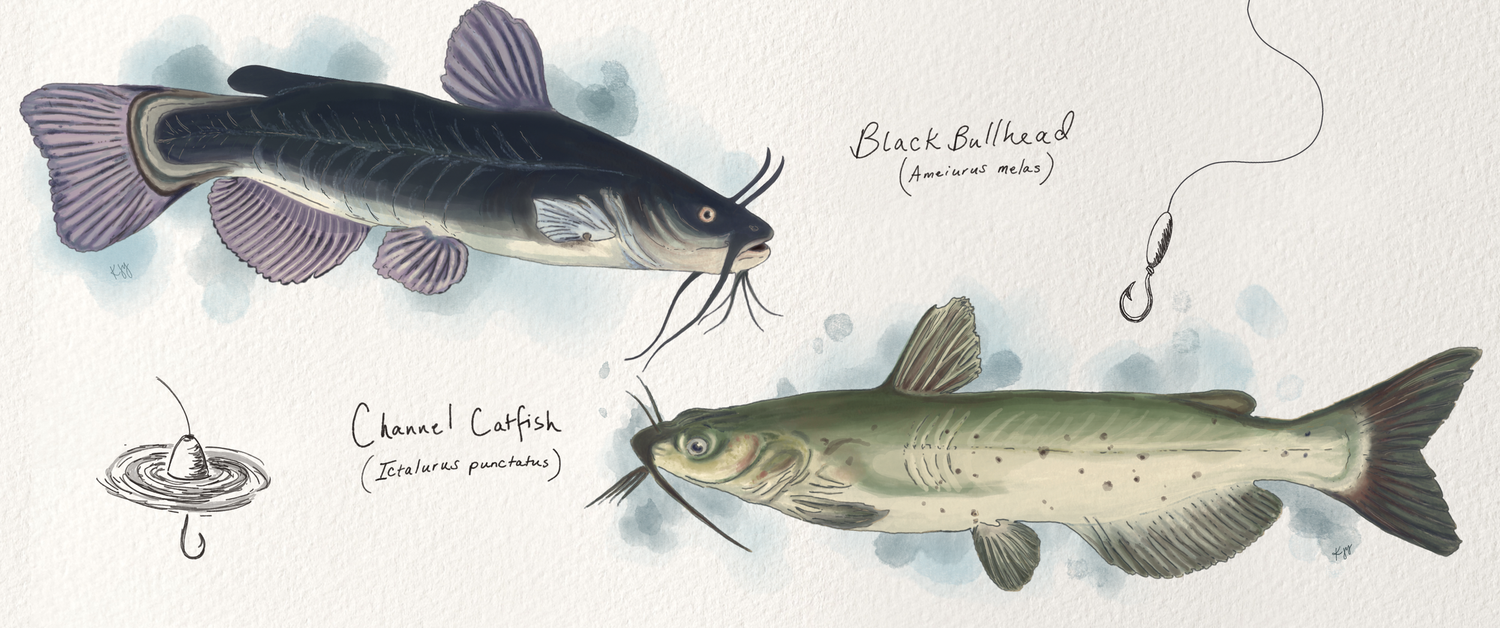
According to recreational catch logs on the fishing app Fishbrain, "Chinese Catfish Pond" provides far more total catches, specifically black bullhead and channel catfish, than its much larger neighbors, Lake Angela and Lake Mary. Beyond these social posts, however, no official data exists on the population. Cut off from feeder streams and thousands of miles from their native Eastern U.S. spawning grounds, the catfish nevertheless manage to persist, surviving freezing winters in an isolated, high-altitude pond.
Once Stashed As Food, The Fish Survive Alone
While most hatchery trout perish over their first brutal Sierra winter, those that evade hooks and predators face a slower, more insidious fate: extreme adaptation, genetic isolation, and metabolic decline. To see where today’s stocking strategies could eventually lead, one only needs to hike 1.4 miles off the beaten path to the small, shallow basin that is known as Chinese Catfish Pond—a 160-year-old preview of what happens when introduced species defy the odds.
Fifteen years after California gained statehood in 1850, intrepid railroad crews set up camp on the slopes just downhill from the pond as they pushed the Transcontinental Railroad (TCRR) through the Sierra Nevada. These trains brought the region—known today as the city of Truckee—its earliest influx of non-native crops and livestock.
As tracks crept toward their final destination of the San Francisco Bay, supply cars ran to the end of the line to feed hungry workers. Facing delays between shipments, including a food cutoff, the resourceful crews likely mixed imported meals and local agriculture to cultivate their own food sources along the rocky mountainside. Among those early imported shipments were live fish.
"Catfish in general are not native to California," said Hilda Kwan, an environmental coordinator with the U.S. Forest Service. "Based on records, the TCRR allowed fish to be brought across the country, both ways."
Today, the TCRR’s tracks and tunnels lay in worn remains along the side of trails that have led to the pond since its 1860’s construction. At first glance, this rugged, snow-draped terrain seems like an improbable location for fish stocking—let alone a transcontinental railroad.
“The common argument I’ve heard is that the workers were never in a spot long enough to feed and propagate the fish,” said Kwan, addressing the catfish origin mystery. However, she notes one key exception: Summit Camp, located just downhill from the pond, where crews maintained a long-term presence from 1865 to 1869.
If Chinese workers didn't stock the catfish, early hotel owners or local horticulturists might have. Both groups had ties to the railroad and were known to experiment with introducing non-native species. With conflicting accounts dating back to the late 1860s—and official railroad logs claiming catfish didn't arrive in the region until 1874—the exact origins of the pond's population remain unsolved.
Severe winters posed a constant threat to all firstcomers and caused the deaths of the nearby Ice Lakes’ first settler and fish stocker, as well as a group of Chinese workers whose bodies were trapped beneath the snow until the spring thaw. Whoever ultimately planted those first generation catfish likely moved on, leaving the fish to endure the freezing waters and defy expectations for generations.
Unstudied Genetic Divergence and Decline
Deprived of new genetic input and forced to survive near-freezing conditions in a shallow pool, the catfish have adapted through a biological trade-off: stunted growth. Rather than growing to normal size, they remain hand-sized, conserving energy to survive the winter freeze.
“They’re a super hardy species,” said Smith, specifically about the adaptive capabilities of catfish, “It’s just a theory, but in cold temperatures, [they can undergo] a sort of pseudo-hibernation where they have this incredibly slow metabolic rate.”
A study directly induced this state over a 28-day window and found that channel catfish in cold treatment showed better body weight, growth factor and other adaptive metabolic indicators as opposed to feed-deprived fish. The photos of the fish at Catfish Pond already reveal smaller than average body size, about the length of a hand–where 160 years of freezing winters have likely taken their toll. Yet the pond thrives with dozens of splashing fins after every snowmelt.
Ironically, that kind of abundant activity is exactly what modern state stocking programs try to recreate in nearby lakes. But unlike the self-sustaining population in Chinese Catfish Pond, current hatchery practices focus on short-term numbers for recreational fishing rather than long-term ecological survival—often without accounting for the unintended consequences if those introduced species do manage to endure.
Because the catfish are exceptionally adaptable, and uniquely displaced into the Sierra Nevada’s more climate change-sensitive western region, the rapid genetic change pushing the pond’s carrying capacity limits could topple towards inward decline. In current-day abnormally hot California summers, local fly fishermen already assume the demise of sport species fish.
This extreme genetic bottleneck makes isolated alpine ponds uniquely volatile. When a population draws from a tiny pool of ancestors in a stress-heavy environment, rare genetic mutations can rapidly spread. That vulnerability was highlighted in July 2026, when researchers identified the first recorded case of transmissible skin cancer (melanoma) in a cousin species of lake-bound bullheads. At higher elevation and with a much smaller habitat size, the fish of Chinese Catfish Pond seem to be candidates for similar genetic studies.
For now, the fish remain tucked away at the end of the 1.4-mile trail, living in an algae-green pool that reflects the surrounding Tahoe National Forest pines. To date, the fish are untouched by any scientific or formal investigations, but are affectionately regarded by local rangers and loyal stewards. Even if greeting public visitors every warm season–the mystery of how these fish arrived remains uncovered within the region's history.